Monday, September 24, 2012

Grand Canyon

the Watchtower was originally built in 1932 by Mary Elizabeth Jane Cutler.  It was intended to replicate many of the towers that are found in the Southwest.  This is the original tower.  The tower was used as a means of food storage and also for defense from attackers.  By the use of a ladder they would climb up to the several landings and then pull the ladders up after them.  Thus the attacking tribe could not gain access.

 
Inside Looking down from next level
There are stairs on the inside that wind around the outside of the tower that allow access to the levels of the tower.  You can go up three levels. The fourth level is the roof.  They will not allow you to go up to the roof.  The picture below is a huge wall Murial the is on the first level of the tower.
This Murial is an attempt to capture the various forms of Native American Art collected from various sources.  The large picture is a depiction of the Kiva.  The tower is constructed  There is a large fireplace on the first level that is the vent for the fireplace in the main store.   The stairs inside are a modern invention that would represent the ladders used anciently inside the structure.  Sister Gardner would not climb up.
Wall Murial
This is the remains of an ancient Kiva or ceremonial circle.  The fire pit can be seen
in the middle of the circle. This is in the Tusayan ruins.


The statue above is Elder Gardner.  I get kidded about the rigid poses that I take when I have my picture taken.  I am in front of an area that is a living quarters.   To the right this is a picture of a series of circles that were used for food storage and living quarters.

 We are allowed to visit the various sites in our mission.  The East Entrance to the Grand Canyon is about 40 miles south of Bitter Springs.
Add caption
These are pictures of the Grand Canyon.  In the far distance from where Sister Gardner is standing you can see Echo Cliffs area that runs the length of our branch.  From Lees Ferry to the Gap.
It is amazing to me that is some of the areas the Oriental tourists would crawl over the fences and go to the outer edges to get a better picture.  One can only guess what is in the small cavity called "the brain".           The canyon is immense.  The drop-off in some of the observation areas are over a mile.  One wonders why you would walk to the edge of a point just to get a better picture.
This sweet Native American lady is picking up Pinyon nuts of the ground.  I went over and helped her pick up some nuts and put them in her sack and she offered me a key chain to thank me.  The "season" for Pinyon nuts is in full force.  They are the size of a large watermelon seed.  When the are ripe the cone bursts and the nuts are on the ground.

Friday, September 7, 2012

Our Squashkin

        There are two Banana Winter Squash like these in the mission.  Ours and one at a place called Lukachukai at Inscription House.  The Winter Banana is an open pollinated squash and there is a genetic combination that gives this result.  At Lukachukai there is not a pumpkin within miles according to Brother Seely who is our specialist that teaches at BYU.  We have dubbed this as a Squashkin because it is right next to our Pumpkin plant.


The squash measures 17.5 inches high and is 15 inches across the middle of the plant.  There are only two squash on the entire vine.  The second squash is just a little larger than the one that Lyndy is standing by.  It is covered with vines and leave so it is more difficult to measure and take a picture of that one.                                          The picture on the left is the picture of our Pumpkin.  It is half the size of our Squashkin.
 

Wednesday, September 5, 2012

Rug Spinning


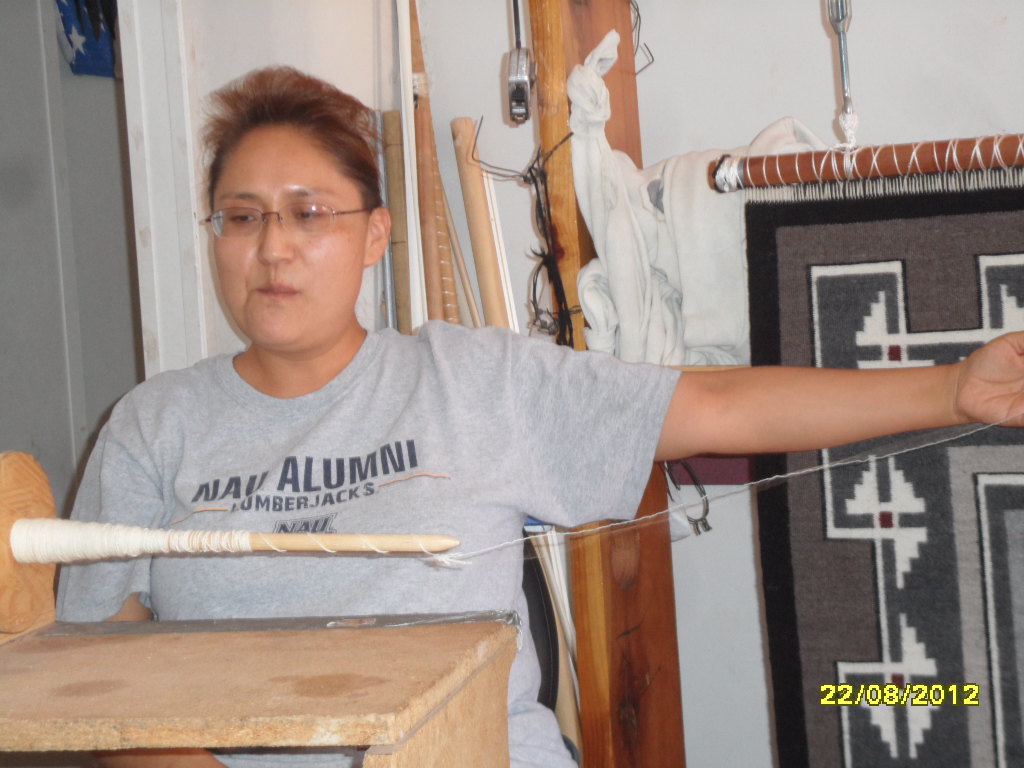
 This is  Geraldine Yellowhair weaving a rug. She is spinning the small strings that form the base of the rug.  (see below)  The strings are the verticle base.  The wool yarn then is placed on the horizontal to form the rug. The pattern is memorized and she visualizes how it should be put on the loom.  The rug Geraldine is workinf on is shown in the background.  It is 4 feet by 6 feet.
Note the small verticle strings.  These
are the strings she is weaving

Legend has it that the partterns that are made were revealed to the men by the Spider Women.  In the past the men were the weavers.  This has now been taken over by the women.
     Geraldine learned weaving from her mother.  She has a 16 year old daughter that she is teaching.

The unit she is using is an old sewing machine
base.  The yarn is spun real tight and then
geathered on the ball at the left.
It is an art that is vanishing from the culture.  The rug shown here will retail in a trading post on the reservation for $6,000.  You can purchase the item from Geraldine for much less.  The have to sell rugs and make various trinkets to survive.

Friday, August 17, 2012

Kneel Down Bread

Grinding fresh corn
 Kneel Down Bread

Grinding corn kernels. This was done with a
rock in a bowl originally.  Modern tools make
the job easier.
 When the corn is ready they pick all of the ears from ripe to almost ripe.  The cut the kernels off with a knife into a large bowl as seen above.  Then the corn kernels are ground into a paste.  The paste is then replaced back into the corn husks as seen below.  The husks with the corn paste are then placed in a fire pit lined with hot rocks.  The husks are then covered with hot rocks and sand and cooked for 2 hours. 

Lucille Begay is Loading husks with the corn paste.

The husks are removed from the fire.  The husks removed and the result is a small loaf of bread.  That is corn bread in the original form.
The taste is very bland.  They also bake the husks in the oven.  You can freeze the cooked bread.  They cut up the bread and put it in soup.

Preparing husks for baking.  Husks are baked
for 2 hours.  Has a mild corn taste.

Wednesday, August 15, 2012

Trailer house people

 
Sloan Family
This family lives across the road fro the chapel. The Kidmans in branch, who are one of the Anglo couples that help, bought these clothes for the kids so they
could go to school. We check on them often  because there are 9 people that live in the trailer. The mattress is put on the porch and it becomes a bed.  We checked on them when school started and the girl agaist the door was not in school.  When we asked her why she replied "I do not have any clothes"
Sloan Family trailer
We try to take them vegetables from our garden.  They have no running water and there is no electricity to the house.  They use a gas powered generator to provide lights and the cooking stove is a BBQ outside the porch you see here.  We are working on getting them to come to church.  They are just a short way away from Grandma Haskie's house that is up the hill to the right of this place. 

Sunday, August 5, 2012


Archeological evidence shows that lpeople have lived here in these canyons for nearly 5,000 years.  Longer than anyone has lived unterrupted on the Colorado Plateau.  The first residence built no permanent homes, but remains of their campsites and images etched or painted on canyon walls tell us their stories.  They lived in small groups, hunted game, grew corn, beans and weaved baskets.  These are ancestors of today's Pueblo and Hopi indians and are often call Anasazi: a Navajo word meaning ancient ones.
The Puebloan people built the multi-storied villages, small household compounds and kivas with decorated walls.
You can see the ruins against the rock wall

People still live in the canyon in order to retain the spirit of their ancestors. Traditional beliefs are reflected in the everyday life. How the Navajo care for their families, live stock and their Homes and how plants are collected for ceremonial, medicinal and traditional uses. They feel that it is important that they retain their cultural ties while attempting to adapt to the new physical demands of the world around them. The walls of the canyon start at 30 feet outside of Chinle to over 1000 feet at the Spider Rock.  This an explanation of the small ruins above.
information board.
Spider Rock.  They believe that this God has taught them
to weave and make baskets.
Right column of the Spider Rock
Overlooking the left column of the Spider web.  There are two large columns.  We are about 1,000 feet above the surface.  A cute German lady and her daughter took our picture.  The hsband did not like heights.  Sounds like Mom!  The road going along the ridge is about 17 miles long.  The people in this canyon have had many periods of famine, weather and in 1863 by Kit Carson who systematically attempted to destroy the people in the canyon.  It was not until 1925 that the people were allowed to return to the canyon and rebuild their homes.  They then were allowed to draw from food distribution centers and scarce food supplies. 

This is the Historic Hubble Trading Post.  It was built in 1876.  Hubbell purchased this property from William Leonard and started a trading post.  The part of the building in the picture is the original building.  It has a wood burning stove in the middle of the floor used to heat the buildings.

Sunday, July 29, 2012

The picture below is what our garden looked like when we started 2.5 months ago.  You can also see the size of the garden.  It is hard to imagine a garden growing in the middle of nowhere.
Garden when we started our mission.
This is our garden now.  You can see Lyndy
behind the corn in the middle.  The leaves in
the bottom of the picture were squash we
replanted.  They are now over 12 inches in
diameter.
You can see the upper corner of the garden.  We had to extend or  go south or to the right of that point by 4 feet and another 4 feet closer to the parking.
We how have the fence in front of Lyndy that goes to the edge of the gravel.  


The Pumpkin .
Tthe Pumpkin started between the fence and
the windscreen. We had to cut a hole in the
windscreen to allow the pumpkin to grow. The
fence outside the Pumpkin was to keep the
rodents off while it had a chance to grow.

This is two of the Zuchinni that we have gotten off of  our garden.  We take the produce we grow and use it for a "gift" to get us into doors.  Many people have a difficult time with the size and quantity of the food we get.
We had visitors from the Humanitarian Depatment visiting our gardens this week.  They were amazed at what we have been able to accomplish.  We have 25 gardens now with 14 more to date that want gardens next year.  It has been a great door opener for us as we visit the inactives.  The church wants us to start having the people purchase some of their own seeds or dry and store the seeds from this years crop for planting later.  We told them we have to get the people active in our branch first.  We do not have any Priesthood Quorums organized in the Branch.  We have activated a few brethren for a potential Elders Quorum Presidency.  They will eventually take over the management of the garden projects.  The Presidency will conduct training classes and work to get more self sufficient.  Now there is one couple that does all of that.


Hogan...
You will see many of these abandoned Hogans all over the Reservation.  We could not figure out why we saw so many close to houses.  Traditionally, if someone dies in a Hogan then the remaining family vacates the home. It is taboo to return to the Hogan for fear of disturbing the sleeping spirit.   We met one lady that had a very nice 4 bedroom trailer.  Her husband died and the adult children would not return to the home so she let the company that sold them the trailer take it away.  She had a small Hogan like this one pictured built in place of the trailer she was living in.  They will not tear them down or move them for the same reason.

They also use these to establish ownership of an area. If a family moves to an area on the Reservation they will build these to establish the fact that that area belongs to that family.  It is very interesting to see old customs that still exist even with those that are members.  Doing temple work for their ancestors is very difficult.  One of our members said that he had twin brothers die when they were only 2 years old.  I asked what cemetary they were buried in.  He said that his father took them somewhere on the reservation, wrapped them in a blanket and put them in a crevase of a rock.  He does not know where that rock is and his mother will not tell him where they are.  I think she does not remember.  Additionally they will not submit names to the temple without all of the family agreeing to have the work done.  Many of them cling to the old traditions even after they accept the gospel.